This piece breaks down why that shift makes dental one of the more compelling vertical SaaS opportunities in healthcare and where the next wave of value (production-optimized scheduling, embedded fintech, recurring product revenue) is headed.
Why Dental Practices Are Buying Efficiency
Historically insulated from macroeconomic headwinds by steady cash conversion, robust patient demand, and predictable fee-for-service revenue models practice operators are now confronting an unprecedented margin squeeze:
Escalating operating overhead across general dental practices has escalated to an industry average of 60% to 65% of total collections. Underperforming solo practices regularly breach >70%1.
Persistent wage inflation across auxiliary clinical labor (exacerbated by systemic structural shortages of dental hygienists and certified assistants) has driven operating expenses per dentist up ~13.2%1.
Fee schedule adjustments by major payors historically lag inflation cycles by several years creating a severe operational squeeze.
Key Takeaway: In this constrained environment traditional path-to-growth business strategies (i.e. simply increasing patient appointment volume) yield diminishing marginal returns due to capacity bottlenecks and labor constraints.
Macro Imperative: Dental Economics and Margin Compression
Practice P&L Structure
Evaluating why dental practice owners are investing heavily in software requires analyzing the financial structure of a standard clinical practice:
An established general dental practice generates between $666,060 and $1.13MM in gross annual revenue per operating dentist.
Operating net profit margins before owner-operator compensation historically averaged between 33% and 41%3.
Staff compensation represents the single largest operational line item, consuming between 25% and 33.8% of practice collections1.
Research conducted by the American Dental Association (ADA) Health Policy Institute in partnership with the American Dental Hygienists' Association and the Dental Assisting National Board reveals that acute labor market shortages across auxiliary staff have created a major operational bottleneck4.
Further putting pressure on options to respond to margin compression is the underlying mechanics of the dental practice itself:
Practice owners cannot unilaterally raise prices to offset inflation.
Key Takeaway: When open hygiene or assistant positions remain unfilled, practice capacity contracts. Unfilled chairs lead to broken recall schedules, reduced secondary diagnostic opportunity, and an uncompensated spread of fixed facility overhead across fewer billable hours.
This structural economic transformation and flight to achieve higher efficiencies can be segmented into several underlying themes:
Operational Pivot: As margin compression renders traditional volume-driven expansion obsolete, practice management is undergoing an immediate structural shift. What was historically a passive, back-office record-keeping function is now a high velocity, software driven operational discipline with tangible ROI.
Capital Reallocation to Efficiency: To protect EBITDA and preserve owner-operator distributions practice owners are aggressively reallocating capital away from additional administrative headcount and directly into software efficiency.
Discretionary to Mission-Critical: Vertical SaaS platforms, real-time computer vision diagnostic tools, AI-scribes / receptionists, and automated Revenue Cycle Management (RCM) suites are no longer luxury add-ons. They are the core operational infrastructure required to keep a clinic solvent.
Venture Underwriting: From an institutional investment standpoint, dentistry presents one of the single most compelling vertical SaaS plays in healthcare. The thesis is anchored by three high-conviction metrics: a massive legacy replacement cycle across legacy desktop systems, near-zero churn driven by system-of-record stickiness, and expanding Average Contract Value (ACV) through high-ROI clinical workflow automation7,8,9.
Key Takeaway: Legacy PMS lock-in (e.g., historical server data conversion, staff retrain fatigue) remains the number one friction point for practice adoption even in the face of financial headwinds caused by retention of legacy processes. Platforms conquering legacy data migration and offering zero-downtime onboarding will capture market share significantly faster
Why Institutional Aggregators Are Also Buying Efficiency
Scale alone no longer insulates DSOs from severe margin compression. While private equity-backed rollups historically relied on multiple arbitrage and bulk purchasing discounts to generate returns, those initial synergy levers have run their course.
DSOs face the exact same macroeconomic wage inflation, auxiliary labor shortages, and rigid third-party payor fee schedules as solo practitioners, multiplied across dozens or hundreds of clinical sites.
Three recurrent themes have emerged in response:
1. Non-Linear Overhead Scaling in Administrative Operations
Centralizing revenue cycle management (RCM), patient communications, and scheduling teams creates a significant corporate overhead burden when managed manually.
Administrative wage inflation prevents back-office operational expense (OpEx) from scaling efficiently across expanding practice footprints.
Without automated RCM, clearinghouse integrations, and API-driven eligibility verification, headcount requirements scale 1:1 with location acquisition, undermining the operating leverage fundamental to the roll-up thesis and pursuit of creating premium valuations.
2. Clinical Production Standardization
DSO platform growth relies heavily on associate clinicians who are entering clinical practice and often beginning their professional careers.
Unassisted, associate diagnostic yields consistently trail experienced practice owners creating production leakage across locations.
Institutional operators deploy diagnostic computer vision AI across their clinical footprint to standardize diagnostic criteria, elevate baseline case acceptance, and eliminate provider-level revenue volatility across all operatories.
3. System-of-Record Fragmentation & Data Silos
M&A-driven platform aggregation routinely results in a fragmented technical architecture dominated by disparate, legacy desktop Practice Management Information Systems (PIMS).
Operating without a unified, cloud-native database architecture prevents executive leadership from establishing centralized business intelligence, executing enterprise-wide scheduling, or standardizing billing workflows.
Key Takeaway: Software automation has transitioned from an operational tool into a critical financial control mechanism. Deploying integrated SaaS infrastructure is the primary operational lever for DSOs to protect EBITDA margins, preserve debt service coverage ratios (DSCR), and command institutional valuation multiples upon exit.
Solo practices (~59.29% of practice settings operate with higher baseline overheads ranging from 65% to 72%2). To remain competitive against consolidated group networks and preserve independent net margins, non-DSO practices must adopt the same enterprise software automation mindset to bridge the productivity gap.
Re-Framing Automation: Human-Centric Augmentation, Not Headcount Reduction
Human-Centric Automation remains the core objective of deploying clinical AI and back-office software automation. The goal is not staff termination but the absolute elimination of administrative friction:
In an environment plagued by acute auxiliary labor burnout, forcing trained dental staff to spend hours on manual insurance verification, eligibility portal searches, and dictation destroys staff retention.
Software automation absorbs manual administrative burdens, enabling clinical and front-office teams to redirect capacity entirely toward high-touch patient experiences, case presentation, and care coordination.
The Efficiency Engine: Quantifying ROI & Throughput
Venture capital investing in vertical SaaS rests on a clear principle: software platforms that directly generate top-line production or eliminate high variable labor costs command superior pricing power and maintain low retention churn.
In dentistry, modern software efficiencies address the two most critical operational leaks in a clinic: treatment plan non-acceptance and administrative front-office bloat11.
Case Acceptance Bottleneck and AI Diagnostic Assistance
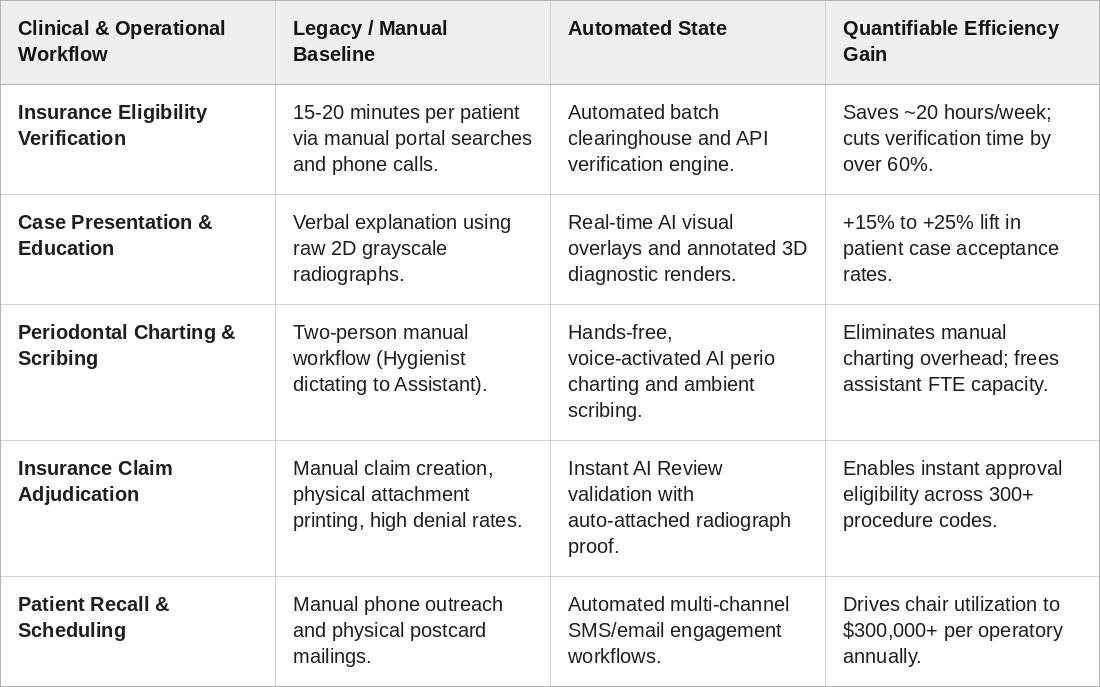
In a standard general dental clinic less than half of diagnosed treatment plans are accepted by patients on the same day13. Industry baseline surveys show actual case acceptance rates hovering between 34% and 50%2.
Key Takeaway: When a dentist verbally describes an early interproximal carious
The primary driver of unaccepted care is rarely clinical validity. It frequently results from communication gaps including patient comprehension of clinical need, provider overuse of jargon mismatched to patient’s level of clinical understanding, and not providing exhibits for patients that provide visual clarity12:
Artificial intelligence diagnostic tools alter chair-side conversion dynamics12. By running computer vision algorithms over digital radiographs in realtime platforms automatically highlight pathologies, color-code decay, and measure bone level loss to 0.35mm accuracy12.
When clear visual AI overlays are integrated into treatment presentations, clinical practices observe a 15% to 25% lift in treatment plan acceptance12.
Customer data across active diagnostic AI deployments demonstrates average ROI multiples reaching ~18x driven by chair-side conversions and diagnostic standardization across associate dentists12.
Clinical studies confirm practicing dentists detected more caries and 91% detected more periodontal disease when assisted by AI visualization tools.
It must be stressed that these technologies do not replace the provider’s clinical expertise or their ability to provide care. Instead they act as a detection amplifier that converts latent clinical need into realized revenue17.
Key Takeaway: On a practice case pipeline diagnosing $1MM+ in treatment annually, raising case acceptance from 45% to 60% unlocks incremental high-margin production without incurring additional patient acquisition marketing spend12.
Operational Throughput Tracking Deficit
A fundamental weakness in clinical dental management is the complete lack of real-time operational throughput tracking:
Traditional practice management systems operate as static financial ledgers rather than dynamic operational telemetry hubs.
Practice owners and DSO executives frequently lack granular, real-time data on key production indicators: operatory chair utilization rates, diagnosis-to-presentation conversion velocity, associate treatment yield variance, and scheduling idle time.
Modern vertical SaaS solves this by converting raw clinical activity into real-time operational dashboards, allowing practice managers to optimize operatory throughput dynamically.
Front-Office and RCM Automation
Administrative efficiency yields direct labor savings11. Front-desk staff traditionally spend dozens of hours every week manually verifying insurance eligibility, submitting claim attachments, and managing appeals12.
Insurance management represents a fast-growing application segment within practice management software due to complex payor rules and expectations of clean claim submissions7.
Key Takeaway: Automated insurance verification systems reduce front-office processing overhead by over 60%, recovering roughly 20 labor hours per week per practice location12. This administrative efficiency directly offsets the need to add administrative headcount as patient volume scales1.
System-of-Record Integration Friction as a Competitive Moat
Database integration represents the single highest barrier to entry and friction point in healthcare vertical SaaS. Legacy desktop PIMS rely on proprietary, encrypted local databases, forcing third-party software vendors to rely on complex database scraping, fragile local sync agents, or expensive gateway APIs.
Software platforms that successfully execute deep, bi-directional, real-time synchronization with dominant legacy databases overcome a massive technical distribution barrier and establish a distinct VC underwriting moat.
Platforms offering native, open-API cloud architectures eliminate integration friction entirely, establishing a structural distribution advantage over closed incumbents.
Closed PMS Trap: Diminishing Returns of Monolithic Systems
Excising the “Closed Architecture Tax” of legacy and self-built PMS architectures should be an immediate goal of any efficiency program. Friction points that operate as closed ecosystems (or explicitly restrict third-party point-solution integrations) suffer from accelerating diminishing returns.
Monolithic legacy systems cannot innovate quickly enough across disparate verticals such as diagnostic computer vision, ambient voice scribing, embedded patient financing, and automated clearinghouse adjudication simultaneously.
Closed PMS platforms force practices into inferior, native point solutions, creating a compounding operational disadvantage against practices running modern, open-API cloud architectures.
Transition to Cloud SaaS
A requirement for practice efficiency is the adoption of the underlying infrastructure capable of supporting the emerging technologies and solutions. A view of the global dental software market demonstrates an ongoing structural displacement cycle as the legacy desktop Practice Management System (PMS) give way to cloud native platforms capable of deploying integrated AI workflow tools8.
Cloud Displacement Cycle
Historically dental software ecosystems were dominated by legacy desktop applications installed on local office servers (Dentrix - Henry Schein, Eaglesoft - Patterson Companies, and Open Dental.)
On-premises deployments accounted for 67.73% of active practice installations in historical baseline surveys7. While initially providing onsite convenience, local server architectures present significant technical liabilities, requiring manual nightly data backups, physical server maintenance, complex VPN configurations for multi-location practices, and fragile third-party plugin integrations.
Market buyer behavior has now reached an inflection point driven by cloud software solutions eliminating hardware costs and need for on premises solutions. Buyer sentiment now favors cloud deployment solutions due to convenience, cost, efficiency, and reliability:
Over 80% of new dental software contracts signed in North America now specify cloud-hosted deployment models8.
Cloud platforms represented a 58.4% deployment share in broader software studies, with web-based solutions commanding 43.6% of overall market revenues8.
Modern cloud platforms consolidate practice management, digital imaging, clinical charting, patient communication, and revenue cycle management into a single browser-native operating system.
Cloud architecture allows multi-location DSOs to centralize billing operations, access real-time enterprise analytics, and instantly deploy AI updates without local server maintenance.
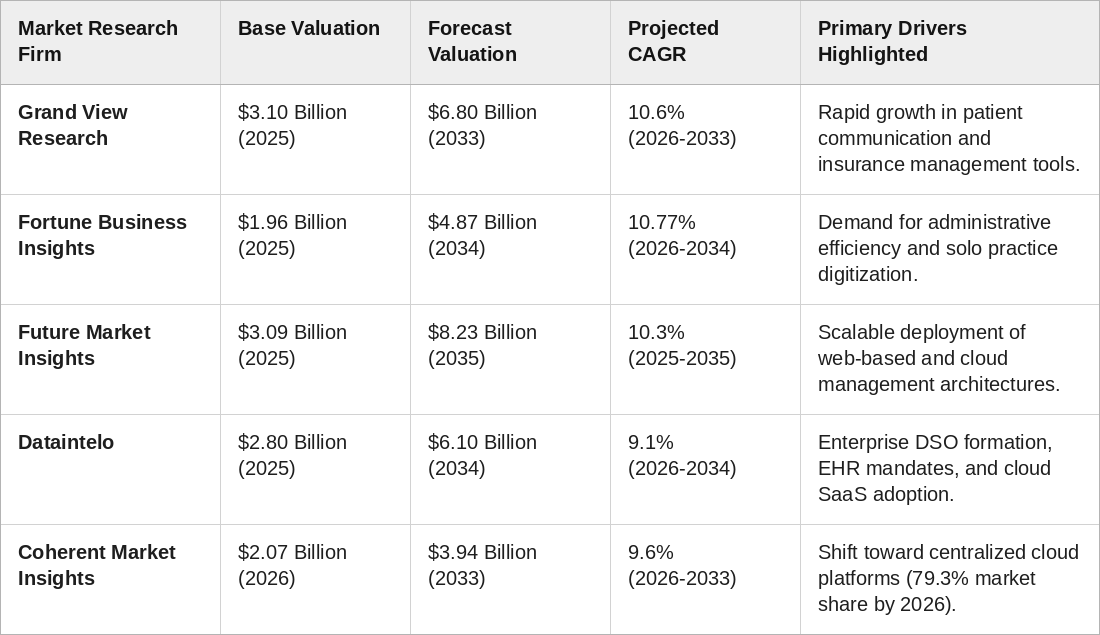
Market research across institutional analytical firms projects steady high-single-digit to double-digit compound annual growth rates (CAGR) for dental software through the mid-2030s7.
VC Investment Thesis: Moving from V1 Point Solutions to V2 Platforms
Vertical SaaS outperformance is fundamentally a function of expanding Net Retention Rate (NRR) and Average Revenue Per User (ARPU). The dental sector represents one of the few remaining multi-billion-dollar healthcare verticals where legacy technical debt, structural market fragmentation, and payment friction coincide.
By executing a phased entry (moving from system-of-record control to operational automation, case acceptance tech, and embedded fintech) software platforms can transform from low-margin point solutions into indispensable, high-margin operating systems with multi-location enterprise level adoption.
We’ve identified several stages of this adoption process:
Stage 1: Re-Platforming from Systems of Record to Systems of Action
First-generation dental software functioned as a passive "System of Record" a basic database used to store patient demographics, tooth charts, and ledger balances8.
Modern venture-backed vertical SaaS platforms function as proactive "Systems of Action"11:
By embedding native AI scribes, voice-driven periodontal charting, automated insurance eligibility verification, and SMS patient re-engagement workflows directly into the core platform, software actively executes back-office tasks11.
When software moves from recording clinical activity to performing labor, software vendors transition pricing models from basic seat-based SaaS subscriptions ($200–$400 per month) to value-based platform tiers ($1,000–$3,000+ per month per location), expanding the addressable market size as enterprise optimization becomes a driver for expansion11.
Stage 2: Diagnostic AI as a High-Margin Growth Engine
The emergence of computer vision diagnostic platforms has created an active category in healthcare venture funding18.
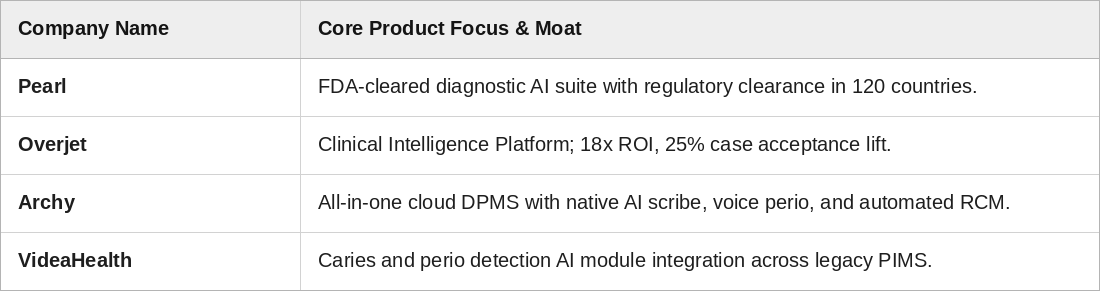
As example, Pearl and Overjet have secured substantial venture and growth capital rounds due to their clear ROI metrics12. Their model and venture validation serves as a roadmap for dental AI’s reliance on a dual-sided market structure18:
Diagnostic AI platforms navigate a dual-sided market structure: enabling clinicians to validate legitimate diagnostic yield while providing payors with objective visual documentation for rapid claim approval of clinical quality26.
Standardizing radiographic interpretation allows insurance carriers to automate claim approvals, while providing clinicians with objective proof to prevent claim denials12.
This creates a dynamic where practices adopt software to boost case acceptance, reduce administrative and scheduling burdens and streamline billing while insurance payors incentivize AI documentation to reduce billing ambiguity and track longitudinal behavior and outcomes across their covered lives and contracted providers12.
Key Takeaway: Payors and providers operate within a unique data rich environment that has provided an emerging landscape for operational deployments: Payors deploy AI primarily for utilization management and claims accuracy whereas providers use AI to optimize operational throughput , quality, and patient centered case acceptance
Stage 3: Monetization Layering via Embedded Financial Technology
In a standard dental clinic payment processing, patient financing, and insurance claim settlement account for massive annual payment volumes2:
Vertical SaaS providers that embed native merchant payment processing, digital financing, and clearinghouse transaction pipelines capture high-margin fintech revenues alongside recurring SaaS subscriptions21.
Capturing 50 to 150 basis points on credit card collections and patient copayments, combined with per-transaction fees for real-time eligibility checks, expands Customer Lifetime Value (LTV)12.
Higher LTV allows vertical SaaS platforms to absorb higher Customer Acquisition Costs (CAC) to acquire practice locations rapidly8.
Underwriting Thesis: Commoditization of V1 Dental AI
The dental efficiency market is continuing to advance into the next cycle of product evolution8. A retrospective on what we have identified as V1 Solutions has been provided in order to provide a holistic view as we trace emerging V2 Solutions built upon these early successes.
Key Takeaway: While 2020 - 2025 was defined by cloud migration and point solutions i.e. diagnostic computer vision, the next wave focuses on generative AI and autonomous workflow orchestration8.
A selection of V1 solutions and their impact are discussed below:
Hands-Free Ambient Dictation and Voice Charting
Hands-free ambient scribes systems allow clinicians to dictate clinical notes, charting observations, and periodontal measurements naturally during patient exams11:
Eliminating the 5 to 10 minutes of manual keyboard charting required per patient visit, dentists recover up to one hour of clinical time daily, enabling additional procedure bookings without extending working hours2.
Autonomous Claims Adjudication
Legacy clearinghouse model (characterized by manual claim generation, physical radiograph attachments, and multi-week payor review cycles) is being replaced by real-time API adjudication networks12:
Utilizing FDA-cleared diagnostic AI to automatically attach verified radiograph evidence to dental claim codes modern software platforms enable instant pre-authorizations and clean-claim first-pass rates exceeding 95%12.
This compresses accounts receivable (A/R) settlement windows from an industry average of 45 days down to single digits, optimizing working capital for practice operators12.
Emerging Horizons: Moving Beyond V1 Commoditized Point Solutions to V2 Dental AI Platforms
First generation dental AI (specifically standalone AI receptionists and basic 2D radiographic computer vision) is rapidly undergoing commoditization.
As these point solutions become table stakes rather than enterprise differentiators, platform value is shifting from isolated software features to end to end operational orchestration.
Key Takeaway: The next valuation and margin expansion cycle belongs to integrated platforms that link dynamic scheduling to high margin clinical production, eliminate the front to back office administrative wall, maximize chairside conversion, and capture recurring patient product revenue.
Examples of note are outlined below:
1. Production Engineered Scheduling
Legacy scheduling systems treat calendar slots as neutral real estate. Next generation platforms engineer the schedule to optimize dollars per operatory hour, matching clinical capacity with margin yield:
Margin Driven Slot Allocation: Algorithms evaluate schedule density in real time, auto routing high margin restorative and surgical cases into prime operatory slots while suppressing low margin hygiene crowding to secure target operatory yields
Predictive No Show Mitigation: Predictive scoring flags high probability cancellations and triggers targeted waitlist dispatches to instantly backfill open capacity with high yield treatment pipeline patients.
Capacity, Load Leveling, and Throughput Matching: Production routing balances procedure complexity against associate speed, optimizing chair utilization and eliminating provider bottlenecks across multi-operatory settings.
2. Unified Financial and Clinical Workflows
The structural disconnect between front desk operations and back office revenue cycle management (RCM) creates persistent leakage, uncollected claims, and inflated OpEx.
Integrated architectures automate the entire pre to post encounter financial pipeline:
Zero Touch Benefit Verification: Automated engines query payor APIs pre encounter to lock in real time eligibility, confirm procedure level coverage, and calculate exact out of pocket patient copays.
Ambient Ledger Population: Operatory scribes convert voice dictation directly into codes, populating billing ledgers in real time to eliminate front desk transcription errors and submission delays.
Instant Claim Adjudication: Clinical documentation (radiographs, perio charts, ambient notes) auto attaches to claims and routes through real time clearinghouse adjudication before the patient steps out of the chair.
3. Advanced Case Acceptance Drivers
Basic diagnostic AI flags pathology, but next generation conversion architectures resolve the clinical comprehension and capital friction that cause treatment deferral:
Generative 3D Visualizations: Replaces flat 2D grayscale X rays with photorealistic 3D renders, showing patients real time simulations of untreated decay progression versus post restoration outcomes.
Financial Execution: Embedded financing engines present real time checkout options, pairing soft credit check micro loans, automated split billing, and HSA or FSA optimization directly at the financial decision stage.
Behavioral Decision Analytics: Systems analyze patient motivational patterns during treatment delivery, dynamically tailoring the presentation toward long term clinical risks financial concerns, and motivations for case acceptance and underlying patient concerns based on historical data.
4. Personalized Care Regimens and Product Attachment
To expand Average Revenue Per User (ARPU) beyond static procedure fees, emerging platforms link clinical diagnostics directly with recurring e-commerce channels:
Automated Clinical Regimens: Software evaluates diagnostic data (periodontal probing depths, caries risk, bruxism) to auto generate customized preventive care plans.
Embedded Chairside Fulfillment: Clinicians prescribe and fulfill clinical grade oral care products (prescription fluoride, custom nightguards, sonic systems, whitening kits) directly through the practice OS.
Recurring DTC Revenue: Automated subscription reordering ships products directly to the patient's home, generating high margin recurring revenue for the practice while driving patient compliance, recall retention, and reducing need for on-premises inventory that can be susceptible to shrinkage or expiration.
Software value is measured against clear clinical, operational, and financial benchmarks. As the availability of SaaS solutions continues to grow the practice administrator or DSO procurement team has begun to experience the adverse effect of overwhelming options for selection.
As an actionable takeaway, we’ve provided several measurements as a quick reference guide for when evaluating which solution to purchase:
Total Practice Overhead Reduction
Software efficiency platforms target reducing total practice overhead from the 62%–67% industry baseline down toward the 55%–60% benchmark maintained by top-performing practices.
Chair Utilization and Revenue per Operatory
High-performing practices generate > $300,000 in annual production per operatory chair vs < $231,000 in average practices1.
Efficiency software drives operatory utilization by automating patient recall, filling schedule gaps via automated SMS outreach, and enabling same-day treatment starts12.
Valuation Multiples and Transaction Readiness
When private equity firms, DSOs, or individual associate dentists acquire dental practices, valuation multiples depend heavily on EBITDA performance:
Investment-grade dental practices target a minimum 20% EBITDA margin9.
Practices maintaining disciplined overhead below 60% command higher valuation multiples (ranging from 1.8x to 2.7x collections, or elevated EBITDA multiples backed by validated digital systems)9.
Practices with uncontrolled overhead above 70% face discounted valuations or earnout structures9.
Strategic Conclusion
Efficiency software has evolved from an administrative utility into a primary financial lever for clinical dental practices. Driven by clinical labor inflation, persistent hiring shortages, and rigid third-party insurance fee schedules, practice operators must leverage technology to expand chair capacity, increase case acceptance, and eliminate manual back-office tasks.
From a venture capital perspective, dental vertical SaaS presents a clear market opportunity. The combination of a legacy on-premises infrastructure ripe for cloud replacement, defensive platform stickiness, high ROI unit economics, and multi-layered monetization through embedded fintech and AI diagnostic assistance positions dental software as a high-growth sector within healthcare technology.
Key Takeaway: Platforms that automate complex workflows, simplify payer interactions, and directly drive clinical production will capture market share as dentistry completes its digital transition
Please enter your information below to receive the full research paper.
Thank you! We'll be in touch!
Oops! Something went wrong while submitting the form.
Partner with us
Shape the Future of Oral Health
Revere Partners is dedicated to co-creating the future of oral health by investing in and supporting the most innovative companies in the industry. We believe in the power of partnership and are committed to working closely with founders and investors to drive meaningful change in the oral health landscape.
Connect with us to explore investments and partnership opportunities — and join us in defining the future of oral health.